This is the Encephalon whitepaper translated for the board. Same methodology as the full whitepaper at encephalon.net/whitepaper/, expressed in board-relevant language: fiduciary risk, audit and model-risk exposure, executive accountability, and four questions every board should answer at the next quarterly review.
Executive Board Summary of Whitepaper
The whitepaper, translated for the board.
Encephalon | March 2026
This is a summary of the full whitepaper. Both are completely free, no email required. Download the Executive Board Summary PDF.
A Summary of the Encephalon Whitepaper
This document is the Encephalon whitepaper translated for the board. The full whitepaper covers the same methodology in practitioner depth, including stakeholder interview frameworks, the Enterprise Bus Matrix, and architectural detail.
Read the full whitepaperThe Thesis in One Paragraph
Enterprise AI is failing at the same 80%+ rate that enterprise data warehouses failed at in the 1990s, and for the identical root cause. Boards are asking why 2025's AI investments are not producing measurable ROI. The answer is not better technology.
It is a discipline that already exists, was already proven across thirty years of enterprise data delivery, and was already paid for by the failures of the 1990s. AI governance is a requirements methodology problem, not a technology problem.
That makes it a governance decision, not a procurement decision, and it belongs at the board level. The Kimball Lifecycle, the requirements-driven approach that solved enterprise data warehousing, provides the structural foundation for governing AI in the enterprise. Organizations that adopt it will avoid the failure modes that are presently consuming their AI budgets.
What the Data Shows
The numbers are consistent across every credible source, and they are converging on the same conclusion: enterprise AI is not failing because the technology is wrong. It is failing because organizations skipped the requirements work.
80%+
of AI projects fail, twice the rate of non-AI IT projects.
Requirements misunderstanding is the #1 root cause. RAND Corporation, 2024.
74%
of companies struggle to scale AI value. Only 4% generate substantial returns.
BCG, 1,000 CxOs across 59 countries.
17% → 42%
share of companies abandoning the majority of their AI initiatives. In a single year.
S&P Global Market Intelligence, 2025.
~6%
of organizations qualify as AI high performers. ~90% use AI regularly.
The differentiator was workflow redesign, not technology. McKinsey, 2025.
52-point
trust gap. Only 9% of workers trust AI for complex business-critical decisions; 61% of executives do. 54% of workers bypassed their company's AI tools in the prior month.
Fortune / WalkMe, April 2026. 3,750 executives and employees across 14 countries.
These are not technology failures. They are organizational and methodological failures, and they are already baked into the 2025 spend that boards are now asking questions about.
The Pattern That Already Played Out
Three decades ago, enterprise data warehouse projects failed at an 85% rate. Gartner originally estimated 60% and revised the figure upward after analyst interviews. The Standish Group's CHAOS Report identified incomplete requirements as the single largest factor in IT project failure.
Ralph Kimball and Margy Ross documented why these projects failed: the technology was not the hard part. The hard part was the requirements work. Understanding what business questions needed answering, how the organization's processes actually worked, and how data needed to be structured to support real decisions. The Kimball Lifecycle codified the answer: start with stakeholder interviews, organize by subject area, deliver incrementally, treat the system as a living asset.
The parallels between data warehouse failure in the 1990s and enterprise AI failure today are not approximate. They are structural:
| Failure pattern | Data warehousing (1990s) | Enterprise AI (2024–2026) |
|---|---|---|
| Failure rate | ~85% | 80%+ |
| #1 root cause | Incomplete requirements | Requirements misunderstanding |
| Common approach | Buy platform, hire DBA, start loading | Buy licenses, configure SSO, start coding |
| What was skipped | Business requirements interviews | Business requirements interviews and organizational knowledge encoding |
| Who paid the price | Organizations that treated it as a technology problem | Organizations treating AI as a tool deployment |
Enterprises should not pay again, in AI dollars, for a lesson the data warehouse industry already paid for in DBA salaries.
Peer enterprises that have published on this problem are converging on the same conclusion. Salesforce, NYSE, Cognizant, and Microsoft have each described AI deployments where the determining factor for success was the organizational knowledge work (encoding standards, conventions, and domain context), not the model selection. The publicly visible failures share an opposite signature: large licensed deployments without convention encoding, declining usage within twelve months, and quiet write-downs in subsequent quarters.
Why Ungoverned AI Is More Expensive Than It Looks
Three failure modes compound at scale and become catastrophic past roughly 50 developers using AI tools without governance.
Every AI session starts from zero. Developers repeat the same context (naming conventions, architecture patterns, security requirements) session after session. For a 200-person engineering team spending 30 minutes per developer per day on context re-explanation, the annual cost is approximately $2.6 million at a $100/hour blended rate. This is before counting governance violations, inconsistent code, or knowledge loss.
AI tools generate insecure patterns, non-compliant code, and architecturally unsound solutions. A 10-person team can catch this in code review. A 200-person team cannot. Volume overwhelms manual review and creates an audit blind spot that risk and compliance committees are now actively flagging, particularly under SOC 2, SOX, and GDPR, and under sector-specific frameworks (HIPAA, PCI-DSS, FINRA, OCC Bulletin 2011-12 model risk management). AI-generated code that cannot produce a defensible audit trail is a regulatory exposure today, not a hypothetical one.
Institutional knowledge lives in senior engineers' heads. Documentation goes stale the moment it is written. When senior engineers leave, their context leaves with them. AI tools cannot access knowledge that was never written down, and what was written down is probably already outdated.
Counterexample
When Spotify encoded organizational context into their AI development workflows (their conventions, their migration patterns, their architectural standards), they achieved up to a 90% reduction in engineering time for code migrations, with over 650 AI-generated changes per month. The productivity gain was a property of the organizational knowledge work, not the AI tool.
The Cost of Delay
Each quarter of ungoverned AI deployment compounds three costs:
The requirements phase typically requires three to six weeks. A board that defers it for a quarter is choosing to add a quarter's worth of ungoverned code to its eventual remediation surface.
Need a board-ready answer this quarter?
A 30-minute conversation about your organization's governance posture, audit exposure, and the path to a defensible attestation.
The Solution
The methodology is the Kimball Lifecycle, extended to make AI feature design a first-class concern alongside business intelligence and dimensional modeling.
It works because it addresses the root cause that kills most projects before they start: skipped requirements. The methodology has four properties that matter at enterprise scale.
Across finance, operations, sales, engineering, security, compliance, and executive leadership. The interviews simultaneously surface BI requirements, AI feature opportunities, and the data landscape that determines which AI features are feasible.
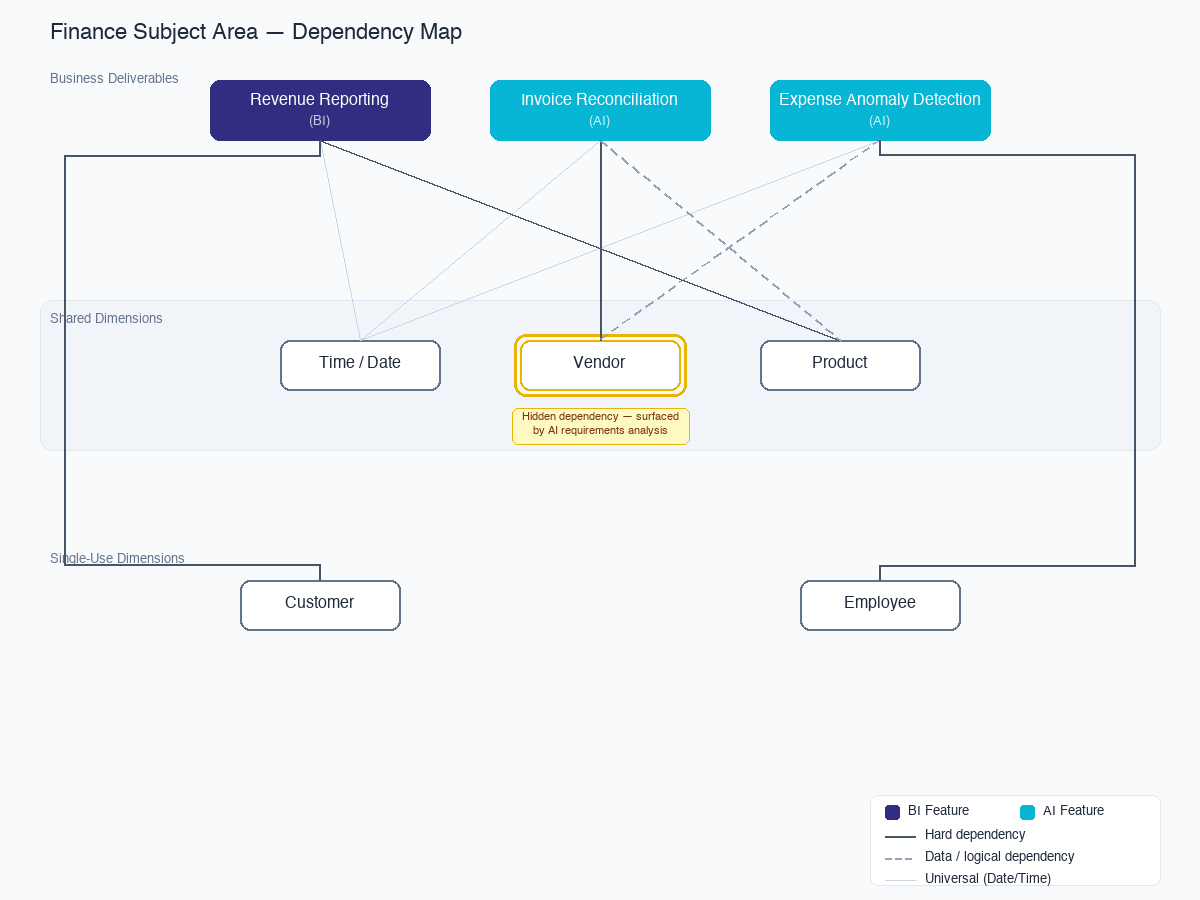
AI features require specific data to function; data availability shapes which AI features are possible. Run as separate projects, the dependencies surface during implementation, the most expensive time to find them. The integrated approach captures both in the same interviews.
Not by technology layer. Each release delivers a complete vertical slice (dimensional model, data flow, BI enablement, and AI feature) that the business can evaluate against its stated requirements. The first subject area is the slowest; subsequent areas accelerate as shared dimensions and patterns are reused.
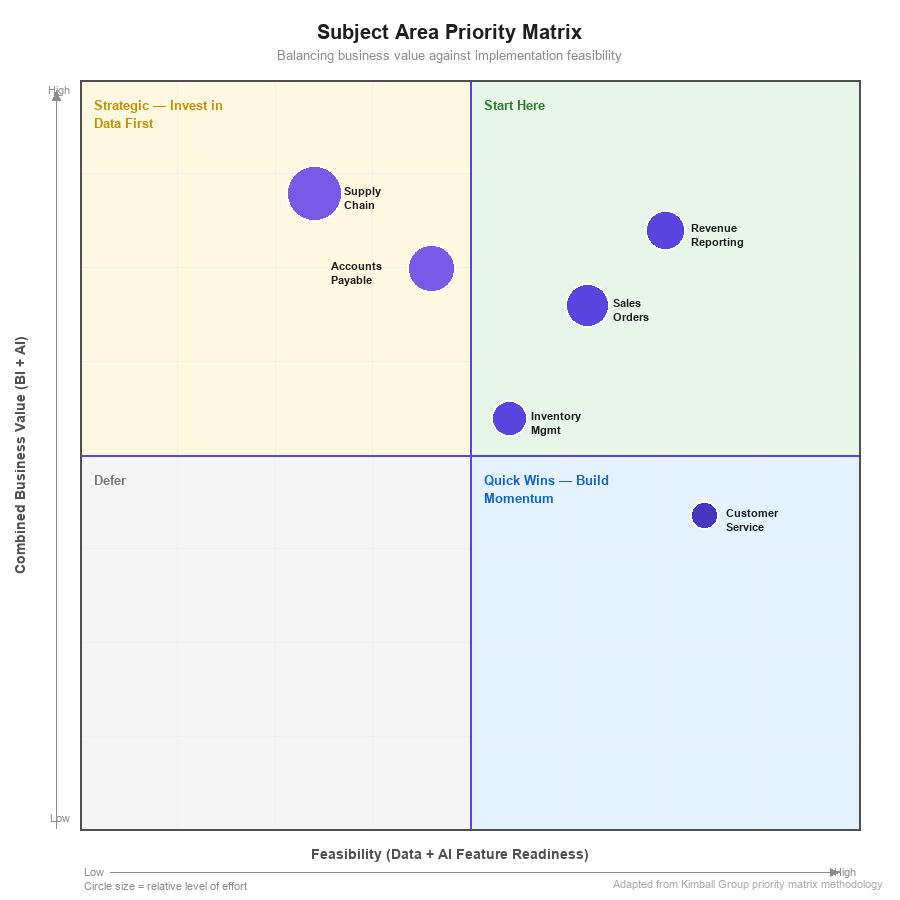
An Enterprise Bus Matrix annotated with AI features, and a Subject Area Priority Matrix that plots combined business value against feasibility. These artifacts drive sequencing, identify "Start Here" subject areas with the best risk-adjusted return, and prevent the most common cause of delay: surprise dependencies discovered late.
The requirements phase typically requires three to six weeks. This is the investment that prevents the 80% failure rate.
Three Governance Principles
The methodology determines what to build and in what order. The governance architecture itself must satisfy three principles regardless of which tools implement it.
Organizational conventions (naming standards, architecture patterns, security requirements, operational procedures) must be encoded so AI tools generate compliant code, and enforced at pull request review so non-compliant code cannot ship. Generation-only governance is bypassed by manual edits. Review-only governance creates adversarial workflows. Governance must operate in two layers: what the AI is taught to produce, and what infrastructure prevents it from leaking regardless of intent.
Security must be structural, not documentary. Operations are gated by environment sensitivity: warned in development, blocked in pre-production, escalated in production. Secrets are never stored in AI context, only references to vault paths. The governance layer makes harm structurally difficult, not merely discouraged.
Governance must persist across sessions, share across teams, and self-maintain, because any system that requires manual upkeep will become stale with certainty.
Build vs Buy
Engineering organizations with strong cultures frequently conclude they can build their own AI governance framework. They are technically correct that the underlying technology is not the barrier. They consistently underestimate the timeline because they conflate technology implementation with methodology design.
The technical infrastructure (encoding conventions, routing requests, gating operations) is a matter of weeks. The methodology design takes months: determining what to encode, how to structure the governance, which conventions to prioritize, and how to handle conflicts between teams. It requires experience the organization does not have because they have never done it before.
Build-vs-buy calculations that include only technology cost systematically understate the true timeline, because they count the infrastructure weeks but omit the methodology months.
The Organizational Change Dimension
AI governance is not a technology project. It is an organizational change project that uses technology as its medium. Four implications follow.
Without executive authority mandating cross-functional participation, the requirements interviews produce wish lists rather than commitments. Without executive authority resolving convention conflicts, standards remain unresolved. Every failed Kimball-era data warehouse project shared this root cause, and every failed AI governance initiative will share it too.
A material incident involving AI in the business (generated code that ships a vulnerability, an AI-driven decision that misfires under regulatory scrutiny, an AI-automated workflow that mishandles customer data) will surface the board's fiduciary question first: who was accountable. If the answer requires a meeting to determine, the answer is no one. The governance question for the board is whether AI governance outcomes have a single accountable owner with a defined reporting cadence to this body, the same as cybersecurity, financial reporting, or model risk under existing MRM frameworks.
AI adoption fails when workers distrust the system. The requirements process resolves this by design: when workers see their domain expertise and long-standing operational complaints captured, prioritized, and reflected in what gets built, the resulting AI system earns adoption from participation rather than from a mandate. The trust that emerges is the hardest gap to plug in enterprise AI adoption, and it is a structural byproduct of the methodology, not a change-management exercise bolted on after the fact.
Every enterprise has two sets of conventions: the ones that are documented and the ones that actually govern behavior. Surfacing and reconciling the actual conventions is one of the highest-value activities in the requirements phase, and it cannot be done without skilled stakeholder facilitation.
The Implementation Sequence
Phase 0: Organizational Readiness
Pre-engagement
Identify executive sponsor. Assess current AI tool adoption, data maturity, and convention documentation.
Phase 1: Integrated Requirements
3 to 6 weeks
Cross-functional stakeholder interviews. Annotated Enterprise Bus Matrix. Subject Area Priority Matrix. Architecture blueprints. Prioritized roadmap. Standalone deliverable with significant value regardless of whether the organization proceeds to implementation.
Phase 2: Subject Area Implementation
Incremental delivery by business domain
Deliver by business subject area, not by technology layer. Each release is a complete vertical slice. The first subject area is slowest; later areas accelerate as shared dimensions and governance patterns are reused.
Phase 3: Operational Maturity
Ongoing
Self-maintaining governance. New conventions encoded as they emerge. AI-assisted workflow operates within a governed, auditable, durable framework.
This is the Kimball Lifecycle applied to a new domain. Its virtue is not originality. Its virtue is that it works. Three decades of enterprise data delivery have validated it.
What This Means for the Board
How much of our 2025 AI spend is at risk because we deployed tools without encoding our organizational knowledge into them?
Could our internal audit function produce a defensible attestation today on AI-generated code in production? If not, what is the remediation timeline?
Who at the executive level owns AI governance outcomes, and what is their reporting cadence to this board?
If a material incident occurred tomorrow involving AI in our business (generated code, automated decisions, AI-driven workflows), do we have the audit trail to explain to regulators, auditors, and shareholders what was produced, who reviewed it, and why it shipped?
Boards that get sharp answers to these four questions will recover ROI on 2025 spend and avoid repeating the failure pattern in 2026. Boards that do not will find themselves in the 80% failure cohort that was already studied, already explained, and already solved by a discipline that has been sitting in the data architecture community for thirty years.
RAND Corporation. "The Root Causes of Failure for Artificial Intelligence Projects and How They Can Succeed." RRA2680-1, 2024.
Boston Consulting Group. "Where's the Value in AI?" Survey of 1,000 CxOs across 59 countries, October 2024.
S&P Global Market Intelligence. "AI & Machine Learning Use Cases 2025." Survey of 1,006 IT professionals.
McKinsey & Company, QuantumBlack. "The State of AI." 1,993 participants, 105 nations, March 2025.
Fortune / WalkMe. Workplace AI adoption survey. 3,750 executives and employees across 14 countries, April 2026.
Gartner (Nick Heudecker). Data warehouse failure rate of approximately 85%, 2017.
Standish Group. "CHAOS Report," 1994. Incomplete requirements identified as #1 failure factor.
Spotify Engineering: up to 90% reduction in engineering time for code migrations, publicly reported by Spotify.
Kimball, Ralph and Ross, Margy. The Data Warehouse Toolkit, 3rd Edition. Wiley, 2013.
This Executive Board Summary represents the views and methodology of Encephalon as of March 2026. Market data and adoption statistics are sourced from publicly available reports and press releases as cited. Encephalon is an independent company and is not affiliated with, endorsed by, or partnered with Anthropic. All trademarks are the property of their respective owners. The methodology described is presented as tool-agnostic guidance. References to regulatory frameworks describe how governance architecture can support operational consistency. Encephalon does not provide compliance certification, audit readiness, or legal compliance assurance.
A 30-minute discovery call to discuss your organization's governance posture, audit exposure, and a path forward your board can stand behind.