TDWI’s AI-Ready Data Foundation Blueprint Confirms the Governance Gap. Its Own Numbers Show the Layer Still Missing.
TDWI began life in 1995 as The Data Warehouse Institute. For decades it has taught the disciplines of the data warehousing era, including the requirements-first Kimball Lifecycle that pulled warehouse projects out of their historically high failure rates. In June, TDWI published a Blueprint Report titled Building an AI-Ready Data Foundation, authored by its VP of Research, Fern Halper, Ph.D.
Its central finding: the divide between enterprises getting broad business value from AI and those stuck in pilots is not model choice. It is the condition of the foundation underneath.
We published The Governance Gap earlier this year making the same argument from the same precedent. Enterprise AI fails at roughly 80 percent, about twice the rate of non-AI IT projects; the root cause is requirements and the broken data underneath them; and data warehousing already solved this class of failure thirty years ago by starting with business requirements instead of technology. When the institution that taught the data warehousing era reaches the same conclusion about AI, that is worth examining closely. Both for where the findings converge, and for the layer TDWI’s own numbers show nobody has built yet.
What the TDWI Blueprint Report found
The report surveyed 167 data, analytics, and AI professionals and segmented them by self-reported AI business impact. The gaps between high-impact and low-impact organizations are large and consistent:
- High-impact organizations adopt domain-level semantic models at 60% versus 17% for low-impact peers, and enterprise taxonomies or business glossaries at 36% versus 7%.
- 63% of high-impact organizations enforce policy directly at the data layer, versus 28% of low-impact organizations, the widest percentage-point gap among the governance capabilities surveyed. The report’s conclusion is blunt: “scalable AI requires governance to be architectural, observable, and embedded into the data foundation rather than treated as a procedural overlay.”
- The belief data points the same direction: 95% of high-impact organizations view the data foundation as required or important for AI success, while 21% of low-impact organizations experience theirs as an active constraint.
Two caveats we would want a reader to apply to our own research, so we will apply them here. The report is sponsored by Alteryx, Snowflake, and ZoomInfo, and its two industry interviews are sponsor executives. And the survey is self-reported with small subgroups, which the report itself acknowledges, so treat the numbers as directional rather than precise. The adoption gaps are the defensible part: they measure what organizations have installed, not what they believe.
The convergence: shared meaning and the context engineering layer
The most striking finding is semantic, not architectural. The capabilities that most separate high-impact organizations from the rest are semantic models, taxonomies, and business glossaries: shared definitions of what the business means by revenue, shipment, or fiscal period, encoded so that systems and people interpret them the same way.
Practitioners who built warehouses through the Kimball era will recognize this immediately. Conformed dimensions, the enterprise bus, a business glossary the whole organization builds against: the discipline existed precisely because analytics without shared meaning produces confident, contradictory answers. TDWI’s data says AI has the same dependency, and that most organizations skipped the work. Our whitepaper calls this the requirements gap, and it is why the Integrated Requirements Methodology adapts the Kimball Lifecycle to AI rather than inventing a new process: the failure pattern is the same one that discipline already fixed once.
TDWI’s blueprint also gives a name to something we have been describing to clients for a year. One of its eight formal layers is the Context Engineering Layer, which transforms semantically enriched data into machine-readable context that AI systems can reuse. Asked to describe a minimal viable data foundation, the report’s executive focus group said the goal is to “build a context layer that is machine readable” that can be “used by multiple agents.”
That is the same vocabulary we use to describe Enterprise Intelligence, arrived at independently by enterprise data executives in an analyst report. The convergence is real, and so is a difference worth being precise about: TDWI’s context layer exists to feed governed data to AI systems. The context Enterprise Intelligence encodes governs the work produced in the AI-assisted session itself. That distinction marks where the blueprint’s reach ends.
Where the blueprint stops
Read the layer diagram carefully, though, and notice what it governs. Data flowing into AI systems, and agent access reaching out to data. Acquisition, standardization, storage, quality, semantics, context, retrieval, consumption. It is a data-layer blueprint, and a good one.
What it does not govern is the work itself: the AI-assisted sessions where code, policies, regulatory documents, and engineering deliverables actually get produced. And the report’s own numbers show that even the winners have not built that layer. Among high-impact organizations, the ones with the unified platforms and the embedded governance, prompt monitoring sits at 11% and hallucination alerting at 4%.
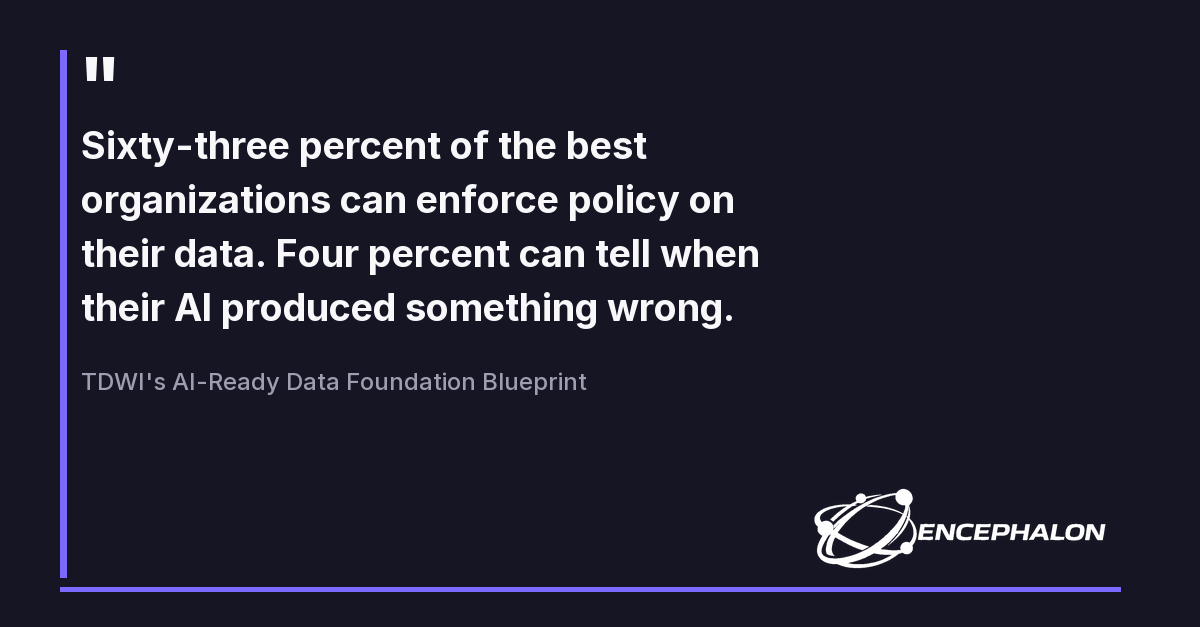
Sixty-three percent of the best organizations can enforce policy on their data. Four percent can tell when their AI produced something wrong. That asymmetry is the governance gap, in one survey table.
The interviews in the report circle this problem without naming it. Rowan Bailey of ZoomInfo warns against letting agents improvise their own queries against raw systems: “you don’t have an agent-ready architecture. You have a gambling problem.” His prescription is bounded, deterministic, well-scoped tools that expose enterprise logic to agents in controlled ways. Jim Lebonitte of Snowflake puts it more directly: “we have all these agents doing stuff now, they’re going to break things,” and argues for containing the blast radius with small, bounded domains.
Bounded scopes, controlled handoffs, containment of failure. That is a description of how AI-assisted work needs to be governed, applied only to the data layer, because the data layer is where the report’s sponsors live.
Governing the work, not just the data
This is the layer Encephalon’s Enterprise AI Governance Practice builds. Governance is a discipline, not a tool you deploy, and the Integrated Requirements Methodology starts where TDWI’s blueprint starts, with cross-functional requirements and a data foundation assessment, because you cannot bolt accurate AI onto broken data and we will not pretend otherwise. But the encoded output does not stop at the data layer. Your naming standards, architecture decisions, regulatory standards, and document formats become governance objects enforced during generation, in the session where the work is produced, not in a policy PDF the AI never reads.
Enterprise Intelligence is the engine that runs them. Long autonomous builds generate a queryable audit trail of what was produced and how. When an auditor, insurer, or client asks how an AI-assisted output came to exist, the answer is encoded provenance rather than a shrug. That is the 4% problem, addressed structurally.
TDWI’s blueprint is the strongest analyst statement yet that AI success is decided beneath the model, and enterprises should take its data-layer prescription seriously. Then look at the prompt-monitoring and hallucination-alerting rows and ask the question the report leaves open: once the data foundation is governed, who is governing the work built on top of it?
If that question lands close to home, the whitepaper lays out the full methodology, ungated. Or bring the question to us directly: book a 30-minute discovery call with the founding team, and we will give you an honest read on where your data foundation and your governance layer actually stand.